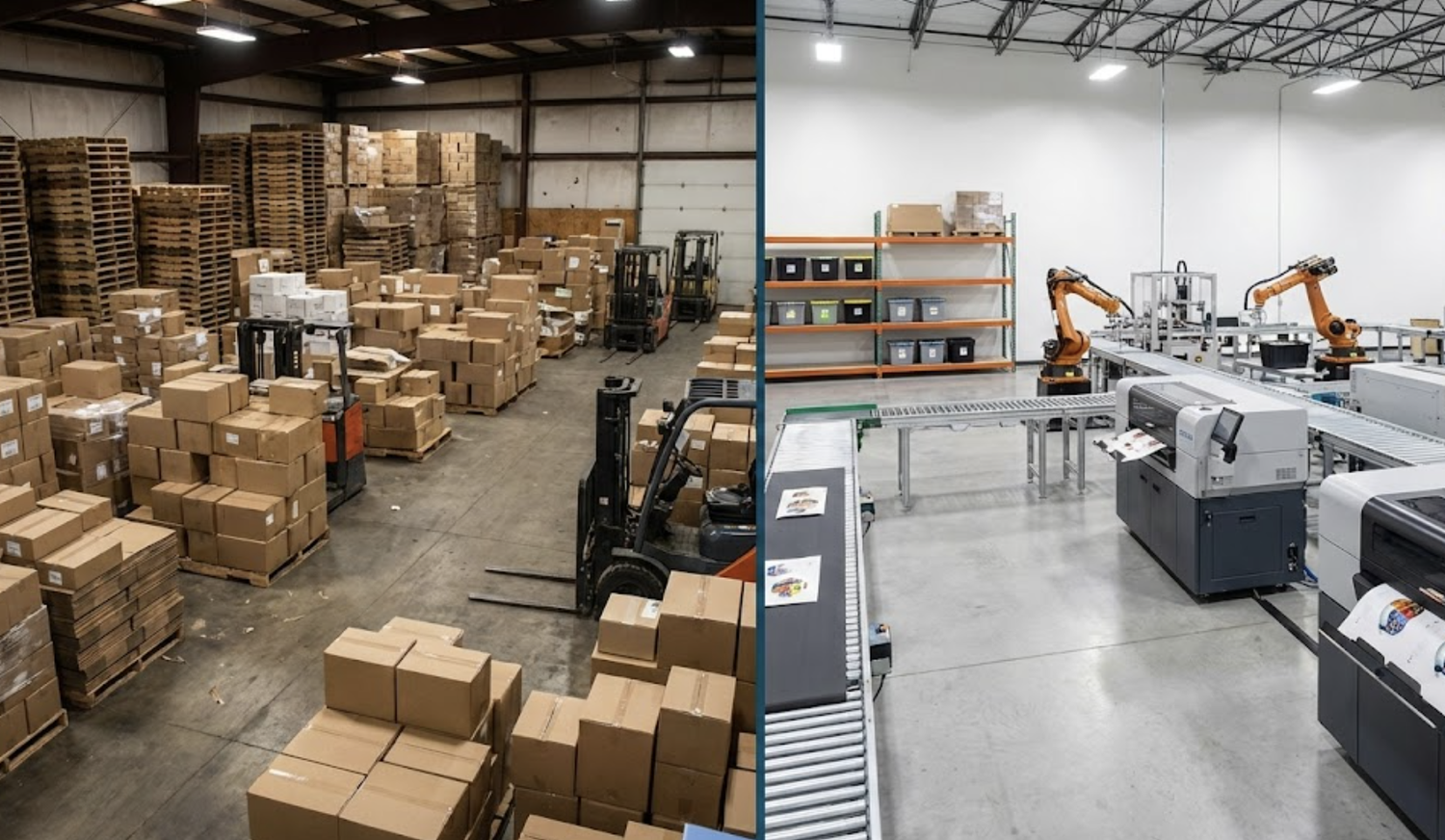
Traditional print distribution adds three to seven days and 20-40% markup to every order. Distributors warehouse inventory, manage regional logistics, and coordinate between printers and customers, creating value through aggregation but introducing costs through multiple handoff points. This model made sense when production centralized in large facilities and shipping took weeks. But production technology, logistics networks, and order management systems have fundamentally changed.
Research on distribution trends shows that 71% of wholesale businesses now sell to customers in other countries, with 54% shipping between 26% and 50% of their orders internationally. This geographic distribution of both suppliers and customers makes traditional regional distribution centers increasingly inefficient. Print-on-demand networks like GelatoConnect eliminate distribution layers, connecting printers directly to customers through automated order routing and local fulfillment.
The economics speak clearly. According to the State of UK Automation 2024-2025 Report, manufacturers are increasingly investing in automation to counter rising costs and improve efficiency. Print-on-demand networks represent the logical evolution of this trend, using software to eliminate intermediaries rather than simply automating their functions.
The Hidden Costs of Traditional Distribution
Distributors provide genuine value by aggregating orders, managing logistics complexity, and maintaining regional inventory that enables faster delivery to end customers. But they also introduce substantial costs that compound through the value chain. Inventory carrying charges consume 15-25% of inventory value annually through warehousing costs, insurance, obsolescence risk, and capital opportunity cost. Each handoff point adds margin (distributor markup, regional facility fees, delivery service charges) that accumulates to 20-40% of final customer price.
When a customer orders printed materials through traditional channels, the job passes through multiple touchpoints. The sales agent takes the order and sends it to a central production facility. That facility produces the items and ships them to a regional distribution center. The distribution center stores inventory until consolidated with other orders for local delivery. A regional delivery service handles final mile fulfillment. Each step adds time (typically 3-7 days total) and cost (20-40% markup accumulation).
Traditional distribution also creates inflexibility. Distributors work best with predictable, high-volume products that justify warehousing investments. Custom, personalized, or low-volume items don't fit their economic model, forcing manufacturers to choose between offering limited product variety or accepting unprofitable distribution costs for niche items. This structural limitation prevents manufacturers from serving the exact market segments growing fastest: personalized products, small batch runs, and rapid prototype-to-production cycles.
GelatoConnect's logistics optimization collapses this chain entirely. Orders route automatically to the nearest production facility capable of fulfilling the job. That facility ships directly to end customers. This direct model reduces shipping costs by up to 40% (shorter distances, no intermediate warehousing) while cutting delivery time from weeks to days. The economic and operational advantages multiply as order volumes increase.
How Print-on-Demand Networks Create Competitive Advantage
GelatoConnect's approach treats local production facilities as network nodes rather than isolated shops, creating capabilities impossible for any single facility to achieve independently. When an order arrives, the system analyzes production capacity (current job loads, equipment availability, staff schedules), material availability (substrate inventory, ink supplies, finishing materials), and shipping proximity (distance to customer, carrier options, delivery requirements). The order then routes to the optimal facility, balancing these factors to minimize total cost and delivery time while maximizing quality and reliability.
This network approach creates several compounding advantages. Printers access larger customer bases without geographic limitations, effectively competing nationally or globally while maintaining local production advantages. Customers receive faster delivery from local production, often within 2-3 days compared to 7-10 days through traditional distribution. The entire network operates more efficiently than any single facility could achieve, sharing capacity during peak periods and redistributing work during equipment downtime or maintenance.
Our procurement module further reduces costs by aggregating buying power across the network, delivering 5-20% material cost reductions. When dozens or hundreds of facilities purchase substrates, inks, and finishing materials collectively, they negotiate pricing previously available only to the largest commercial printers. This democratizes economies of scale, allowing mid-sized print shops to compete on cost with much larger competitors.
The McKinsey-verified research on GelatoConnect concluded that the platform can increase EBIT margins by 3-7 percentage points, more than doubling bottom lines for many PSPs. This dramatic improvement stems from eliminated distribution costs, reduced inventory carrying charges, optimized material procurement, and increased production efficiency through intelligent routing and capacity management. ESP Colour achieved 20% efficiency increases without additional hiring while reducing warehousing cash requirements by 20%, saving $300,000 annually.